

Organic Waste Market Size to Reach USD 58.48 Billion by 2032 Regulations and Waste Segregation Driving Demand
Organic Waste Market
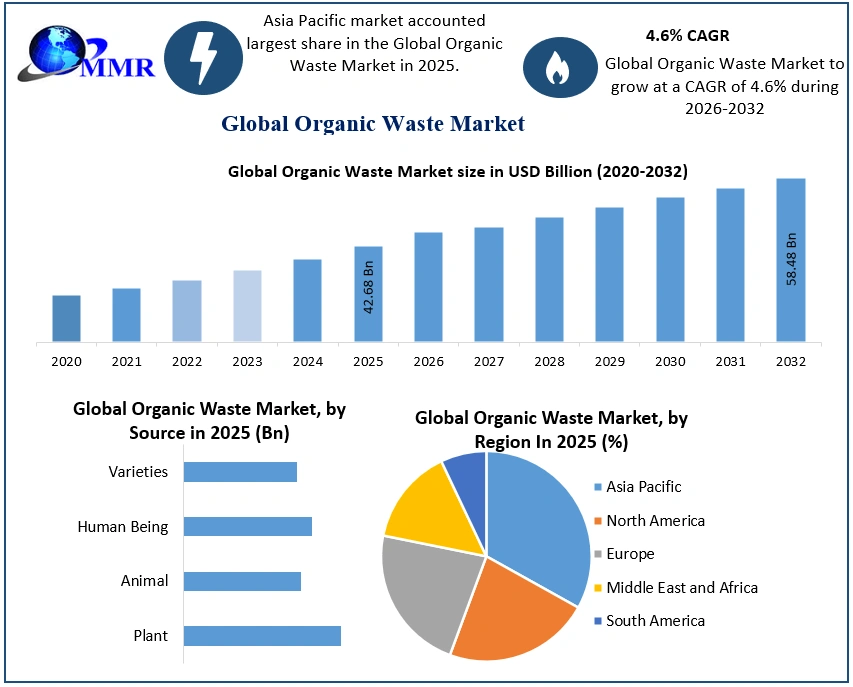
The Organic Waste Market was valued at USD 42.68 billion in 2025 and is projected to reach USD 58.48 billion by 2032, growing at a CAGR of 4.6%.
Every ton of organic matter is now a data point in the Circular Bio-Economy, tracked via digital compliance portals.”
ROCKVILLE , MD, UNITED STATES, March 18, 2026 /EINPresswire.com/ -- The global Organic Waste Market is undergoing a fundamental structural pivot, transitioning from a linear "disposal-based" model to a circular "Resource Recovery" ecosystem. Valued at USD 42.68 Billion in 2025, the market is projected to reach USD 58.48 Billion by 2032, growing at a consistent CAGR of 4.6%, this growth is being catalyzed by the global shift toward "Net Zero" emissions, where organic waste is no longer viewed as an environmental liability but as a critical feedstock for renewable energy and sustainable agriculture.— Maximize Market Research
Get Full PDF Sample Copy of Report: (Including Full TOC, List of Tables & Figures, Chart) @ https://www.maximizemarketresearch.com/request-sample/102098/
A definitive real-world application is seen in the corporate sector, where major entities like Myntra have recently inaugurated dedicated in-house organic waste processing facilities to foster employee wellness and circularity. According to latest industry observations, the integration of Anaerobic Digestion (AD) is allowing municipalities to monetize their refuse, transforming food scraps and agricultural residues into high-value biogas and bio-fertilizers.
Regulatory Compliance – The Shift to Mandatory North American Segregation
The most significant catalyst for market formalization in 2026 is the implementation of stringent regulatory frameworks across North America, notably the full enforcement of California’s Senate Bill 1383 (SB 1383). As of March 2026, this mandate has evolved into a rigorous legal standard, requiring all residents and businesses to separate organic materials—including food scraps and yard trimmings—into dedicated collection streams to achieve a 75% reduction in organic waste disposal. Failure to comply now results in significant financial penalties, moving the industry toward a technology-enabled compliance architecture that prioritizes landfill diversion.
A prominent example of this transition is seen in the City of San Francisco, which has utilized its Mandatory Recycling and Composting Ordinance to achieve one of the highest urban diversion rates in the world. By integrating AI-driven "Smart Truck" monitoring, the city identifies contamination in green bins in real-time, providing instant feedback to generators. This regulatory push is effectively eliminating the "collect-and-dump" culture, providing a transparent roadmap for industrial-grade organic waste processing across both urban and rural North American landscapes.
Carbon Credit Monetization – Turning Emissions into Tier-1 Global Assets
In March 2026, the organic waste market is undergoing a radical financialization, as methane capture projects are increasingly recognized as sources of Tier-1 Carbon Credits. Beyond simple landfill diversion, the global waste sector is now a critical supplier for the Voluntary Carbon Market (VCM), where high-integrity credits from anaerobic digestion and biochar projects are fetching significant premiums. For instance, the European Union's newly adopted Carbon Removals and Carbon Farming (CRCF) regulation is providing a standardized framework for certifying "biogenic carbon" stored in soils via organic digestates.
A definitive real-world application of this global trend is seen in Mafinga, Tanzania, where the world’s first negative-emissions credits were recently retired from a biomass-to-biochar project certified under the Global Biochar C Sink standard. Simultaneously, in North America, projects like Corigin Solutions are converting agricultural shells into biochar to generate durable, 100-year sequestration credits. By transforming "wet waste" into verifiable carbon sinks, operators across both developed and emerging economies are securing long-term offtake agreements, successfully de-risking large-scale waste-to-wealth infrastructure investments.
Market Dynamics – Feedstock Security and the "Waste-to-Wealth" Shift
The trajectory toward a USD 58.48 Billion valuation is being propelled by a fundamental reimagining of organic refuse as a high-value industrial feedstock rather than a disposal burden. The primary market driver is the urgent global demand for Feedstock Security, as energy providers and chemical manufacturers compete for consistent streams of high-quality organic matter to fuel anaerobic digesters and biorefineries. This "Waste-to-Wealth" transition is further accelerated by the rising costs of traditional landfilling, with average tipping fees in North America climbing to approximately $62.28 per ton, making on-site recycling a financial necessity.
A definitive real-world application of this dynamic is seen in the aviation sector, where the surge in Sustainable Aviation Fuel (SAF) production is creating a massive supply-side pull for agricultural residues and used fats. By converting these biogenic materials into energy-dense fuels, industries are successfully decoupling economic growth from carbon intensity, ensuring that the 4.6% CAGR is anchored in both environmental necessity and long-term fiscal resilience.
Market Segmentation – Technical Diversity and the Protein Recovery Surge
The architecture of the organic waste landscape is defined by its transition from "mass-disposal" to "high-precision categorization." Municipal Solid Waste (MSW) remains the largest volume segment, accounting for approximately 44.2% of global tonnage, yet the Industrial and Commercial segments are experiencing the most rapid financial appreciation. This is driven by the "Zero-Contamination" requirements of advanced biorefineries, which demand pre-sorted, high-energy organic streams for efficient conversion. In 2026, a revolutionary sub-sector has emerged: Insect-Based Protein Recovery.
Utilizing Black Soldier Fly (BSF) larvae, companies are now transforming food waste into high-quality animal feed and organic fertilizers in a fraction of the time required by traditional composting. "Bioconversion" is seen in North America, where Enterra Solutions has scaled its facility to process over 100 tons of food waste daily into sustainable protein. Simultaneously, the European Union has seen a surge in Anaerobic Digestion (AD) infrastructure, where municipal "Green Bin" waste is being co-processed with agricultural manure to maximize biogas yields. This segmentation reflects a market moving toward "Nutrient Circularity," where every ton of waste is appraised for its potential as either a renewable fuel, a high-protein feed additive, or a carbon-sequestering soil amendment.
Get Full PDF Sample Copy of Report: (Including Full TOC, List of Tables & Figures, Chart) @ https://www.maximizemarketresearch.com/request-sample/102098/
By Type
Garden Waste
Kitchen Debris
Cooked Food
Paper Products
Human Waste
Other
By Source
Plant
Animal
Human Being
Varieties
By End-User
Municipal
Industrial
Agriculture
Waste Water
Other
By Treatment Technology
Aerobic
Anaerobic
Combustion and Incineration
Regional Analysis – The "Global Smash" and the APAC Surge
While North America and Europe traditionally led the sector’s infrastructure, March 2026 marks a definitive shift toward the Asia-Pacific (APAC) region as the primary engine of market volume. Driven by China’s 15th Five-Year Plan (2026–2030) and the newly released Action Plan for Comprehensive Treatment of Solid Waste, the region is rapidly scaling its "Waste-to-Wealth" capacity. A prominent real-world example is Vietnam, where five major Waste-to-Energy (WtE) plants are currently under construction, each backed by 20-year power-purchase agreements. Simultaneously, the European Union is finalizing its 2026 Circular Economy Act, aiming to double its circular material use rate to 24% by 2030. This cross-continental momentum is establishing a global "ASEAN-to-EU" corridor for biomass technology, positioning emerging economies as the next frontier for large-scale anaerobic digestion and nutrient recovery investments.
Organic Waste Market, Key Players
1 Advanced Disposable Services Inc.
2 Andritz Ag
3 Biancamano S.P.A
4 Biffa Group Limited
5 Clean Harbors Inc.
6 Cleanaway Waste Management Limited
7 Covanta Holding Corporation
8 E.O.M.S. Recycling Inc.
9 Eco Food Recycling
10 Stericycle Inc.
11 Veolia Environment
12 Waste Connections Inc.
13 Waste Management Inc.
14 Quest Resource Management Group Llc
15 Refood Gmbh
Get access to the full description of the report @ https://www.maximizemarketresearch.com/market-report/global-organic-waste-market/102098/
Analyst Perspective – The Rise of Decentralized "On-Site" Processing
Market analysts identify a paradigm shift in 2026 where the industry is moving away from energy-intensive "mass hauling" toward decentralized micro-digesters. In the current landscape, the USD 58.48 Billion market is being redefined by on-site processing solutions that eliminate the carbon footprint of waste transport. Now City of Toronto, which has integrated modular anaerobic digestion into its TransformTO Net Zero Strategy, converting municipal organics into grid-injectable Renewable Natural Gas (RNG) directly at the source. This evolution into "Smart-Facility" designs driven by AI-powered digital traceability—ensures that every ton of waste is appraised as a localized energy asset. By 2032, success will be defined by "Hyper-Local" circular systems that turn waste into immediate community value.
FAQ’s
Q1: How do the New SWM Rules 2026 impact organic waste processing?
Ans: The April 2026 mandate enforces Four-Stream Segregation, legally requiring "Wet Waste" to be processed via composting or anaerobic digestion to avoid steep non-compliance penalties.
Q2: What is "Feedstock Security" in the 2026 market?
Ans: It refers to the competitive acquisition of high-quality organic matter to fuel Sustainable Aviation Fuel (SAF) and Renewable Natural Gas (RNG) production.
Q3: Can organic waste generate Tier-1 Carbon Credits?
Ans: Yes; projects utilizing Biochar or methane capture are now certified under global standards like the EU’s CRCF, providing high-permanence carbon removal credits.
Related Reports
Waste Management Market: https://www.maximizemarketresearch.com/market-report/waste-management-market/13244/
Household Composters Market: https://www.maximizemarketresearch.com/market-report/global-household-composters-market/83198/
Waste Treatment and Disposal Services Market: https://www.maximizemarketresearch.com/market-report/waste-treatment-and-disposal-services-market/69904/
Biotechnology Market: https://www.maximizemarketresearch.com/market-report/global-biotechnology-market/10844/
Green Technology and Sustainability Market: https://www.maximizemarketresearch.com/market-report/global-green-technology-and-sustainability-market/35441/
Top Reports:
Dredging Market
Artificial Turf Market
About Maximize Market Research
Maximize Market Research is a global intelligence firm specializing in the Circular Economy and Renewable Energy sectors. We provide high-fidelity data that bridges the gap between environmental compliance and capital investment.
Domain Focus - Material & Chemical
Our analysts track the convergence of Waste-to-Energy (WtE) infrastructure, carbon sequestration technologies, and regulatory mandates, empowering organizations to capitalize on the USD 58B Bio-Economy through precision-engineered resource recovery and nutrient circularity strategies.
Lumawant Godage
MAXIMIZE MARKET RESEARCH PVT. LTD.
+ +91 96073 65656
email us here
Visit us on social media:
LinkedIn
Instagram
Facebook
X
Legal Disclaimer:
EIN Presswire provides this news content "as is" without warranty of any kind. We do not accept any responsibility or liability for the accuracy, content, images, videos, licenses, completeness, legality, or reliability of the information contained in this article. If you have any complaints or copyright issues related to this article, kindly contact the author above.
