

UChicago Medicine's ECHO-Chicago marks 15 years of telementoring thousands of providers to strengthen community care
It doesn't take much for ECHO-Chicago Director Daniel Johnson to sum up the mindset behind the University of Chicago Medicine healthcare telementoring network he founded in 2010: “Where there’s a role, there’s a way.”
It's that drive that carried ECHO-Chicago to a recent milestone: 15 years of successfully telementoring thousands of primary care providers to expand care in underserved, under-resourced communities.
From Chicago's South Side, across Illinois, to 48 states — and now, to the first-ever ECHO hub in China — the reach of that mission keeps growing.
“I think the most important reason for our success has been passion, believing this is important work to be done and having an amazing team doing the work,” Johnson said.
ECHO-Chicago aims to help community providers better treat complex health problems so that patients can receive timely, high-quality care close to where they live. It does this by providing online training and support to healthcare workers.
“Often, the time it takes for a patient to get an appointment to see a specialist, depending on the topic area, can be anywhere from weeks to years,” Johnson said. “We’re able to up-train primary care providers in order to reduce their dependence on specialists, meaning they can take care of a wider range of patients.”
An innovative program built around “all teach, all learn, all support”
ECHO-Chicago was one of the first programs to emerge from and be funded by UChicago Medicine's Urban Health Initiative and the second of its kind to be modeled after the University of New Mexico's Project ECHO telementoring initiative.
ECHO-Chicago offers free weekly, hour-long training sessions to healthcare providers on medical topics. Sessions begin with a lecture, followed by questions and answers and case studies presented by both the subject experts and learners. Roughly half of the program's 200 subject experts have come from UChicago Medicine.
“Our motto is all teach, all learn, all support,” said Karen Lee, ECHO-Chicago's executive director. “It's not just experts who weigh in on a case, it's the entire group, and they share resources, offering suggestions on different approaches or community resources that can provide their patients additional support.”
Series topics vary, ranging from resistant hypertension and childhood obesity to palliative care and substance use disorders. In recent years, the program has also offered a number of training series on behavioral health.
Topics are selected in partnership with ECHO-Chicago's advisory board, which is comprised of stakeholders including the Illinois Chapter of the American Academy of Pediatrics, the Illinois Primary Health Care Association and the Illinois Association of School Nurses.
With a core staff of eight, the program targets primary care doctors, nurses, medical assistants, administrators, case managers and social workers. It has even worked with judges to help them better understand addiction medication, and with teachers and principals on how to handle COVID-19 in a school setting.
Most of the roughly 5,000 learners who have taken sessions are based in Illinois, but the program has reached learners in 48 states and abroad. Many learners have participated in multiple series.
The program hopes to reach at least an additional 350 providers thanks to a $2.88 million grant awarded last November from the Illinois Department of Public Health. The money is funding training on 18 different topics, including a timely session on common pediatric problems.
“That one will touch on some of the issues of childhood vaccination and as you can imagine, there are differences between what's being presented at the federal level, what's recommended by the American Academy of Pediatrics and what the state of Illinois is adopting,” Lee said. “We'll work through some of those issues as they're happening.”
Engaged online training and support for practical and effective care
All of the sessions are eligible for continuing medical education (CME) credits, although ECHO-Chicago's highly interactive sessions differ from traditional CME webinars because they emphasize real-world, evidence-based practices that can be difficult to capture in a journal article or at a medical conference.
“There's such a huge lag time for somebody to apply the knowledge they gain in traditional CME models like webinars or conferences,” said Lee. “I think with ECHO, because it's smaller doses over time and you're getting support from peers and experts, you gain confidence in applying newly gained skills in real time.”
In follow-up surveys, participants referred 20% to 30% fewer patients to specialists. In separate research, a five-year, Chicago-based ECHO project on hepatitis C training found a 137% increase in the annual number of patients tested and a 61% increase in patients diagnosed at participating sites of care. Several of those sites report continued success with testing and diagnosis of hepatitis C, as well as high rates of treatment.
ECHO-Chicago model going global
Today, more than 1,500 ECHO programs operating around the world are pursuing similar improvements in patient care. As an ECHO Superhub — a licensed provider of training for organizations wishing to launch their own ECHO programs — ECHO-Chicago is helping drive that expansion effort. Working in partnership with the Tongji University School of Medicine in Shanghai, ECHO-Chicago secured a three-year, $900,000 grant in 2023 from the Cyrus Tang Foundation to pilot use of the ECHO model in China. The pilot program aims to up-train community-based clinicians and expand the availability of primary care services in Shanghai and beyond.
“China's health system is trying to rapidly adapt to meet the needs of its population, both in terms of an aging population and chronic diseases, as opposed to more infectious diseases,” Lee said.
The pilot has since grown into something more permanent: ECHO-Chicago is in the process of formalizing the first-ever ECHO hub in China — an achievement the program celebrated at a virtual birthday marking 15 years of milestones.
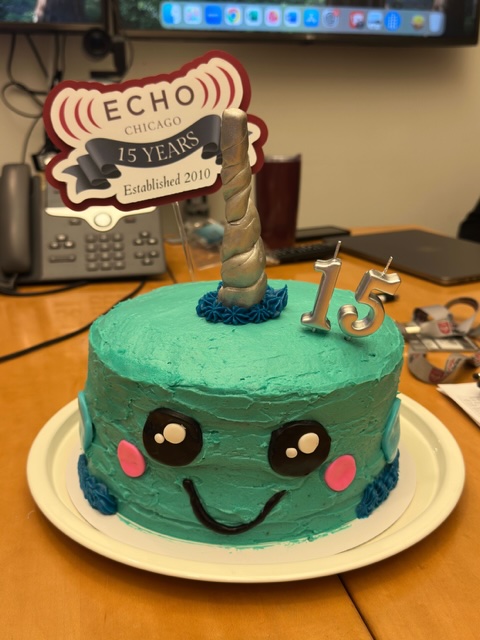
Birthday festivities included program trivia, guest speakers and a chocolate cake baked by Lee styled after ECHO-Chicago's mascot: a narwhal, a horned Arctic whale known to use echolocation.
“They're symbolic in that narwhals form small pods of community,” Lee said. “It's similar to how ECHO-Chicago trains and builds community, one small cohort at a time.”
Legal Disclaimer:
EIN Presswire provides this news content "as is" without warranty of any kind. We do not accept any responsibility or liability for the accuracy, content, images, videos, licenses, completeness, legality, or reliability of the information contained in this article. If you have any complaints or copyright issues related to this article, kindly contact the author above.
